Prophet Solomon (PBUH) in Holy Quran
Soleiman (circa 985 BC - 932 BC), (Arabic: سليمان) is a prophet in the Qur'an who is known as King Solomon from the Bible. Judging from the similarities, the Qur'an and the Bible apparently describe the same person, however the accounts differ on a number of aspects. It is believed that Prophet Soleiman lived only for 53 years
The Arabic version of the name may also be transliterated into Latin alphabet in various languages as Sulaiman, Solaiman, Suleyman, Soleyman, Sulejman, Solejman, Suleiman or Soleiman and may be seen in Latin language texts in Salomon, Saloman, Soloman forms as well.
The story of Solomon, as told by Quranic verses
In the Quran, Soleiman is a son of the Prophet Davud (King David in Bible). He is told to have learned much from his father, and subsequently made a prophet by Allah and given power over all creatures. Ruling a large kingdom that extended south into Yemen, he was known throughout the lands for his wisdom and fair judgements.
Soleiman is said to have been given control over various elements, such as the wind for transportation. In addition he had excellent relations with the Jinn as well as animals:
And to Solomon (We made) the Wind (obedient): Its early morning (stride) was a month's (journey), and its evening (stride) was a month's (journey); and We made a Font of molten brass to flow for him; and there were Jinns that worked in front of him, by the leave of his Lord, and if any of them turned aside from our command, We made him taste of the Penalty of the Blazing Fire. [Quran S34:A12]
And before Sulayman were marshalled his hosts,- of Jinns and men and birds, and they were all kept in order and ranks. [Quran S27:A17]
A well-known story of Soleiman involves his interactions with the Queen of Sheba, Belgheis. Soleiman comes to know about the ruler through a talking hoopoe who states:
I found (there) a woman ruling over them and provided with every requisite; and she has a magnificent throne. [Quran S27:A23]
According to the story, she was a wise ruler, but her people worshipped the sun. Soleiman invites her to submit to "Allah, The Most Beneficent, The Most Merciful". Upon receiving such a letter she requests advise from her chiefs, who are most willing to make war. The Queen, however, responds:
Kings, when they enter a country, despoil it, and make the noblest of its people its meanest thus do they behave. But I am going to send him a present, and (wait) to see with what (answer) return (my) ambassadors. [Quran S27:A34 and S27:A35]
And so the Queen sends gifts to Soleiman. These gifts offend Soleiman, who was satisfied with that which Allah had granted him, and he began to make preparations for war. Meanwhile, the envoys of the Queen returned with the gifts, and the Queen decided to personally visit Soleiman. At this point Soleiman decided to test the Queen. He ordered to bring the Queen's throne from her palace before she reaches Soleiman's court. A proud Jinn claimed he could bring the throne before him (Soleiman) before he (Soleiman) stood up. But a man stood up and said he could bring the throne before the "twinkling of an eye" and as soon as he said it the throne was there. Before the Queen arrived, Soleiman asked to disguise her throne in order to test her. Upon her arrival, she was asked to identify the throne and whether it was hers. The Queen replied:
It was just like this; and knowledge was bestowed on us in advance of this, and we have submitted to Allah (means Islam). [Quran S27:A42]
She was then asked to enter his palace, in which the floor was made of transparent glass built above flowing water. The Queen had not seen or known about glass before, and thinking that her clothes will get wet, she uncovered her legs before taking her steps. To this, Soleiman explained to her what she saw before her and she had by now submitted to God and the two kingdoms were at peace.
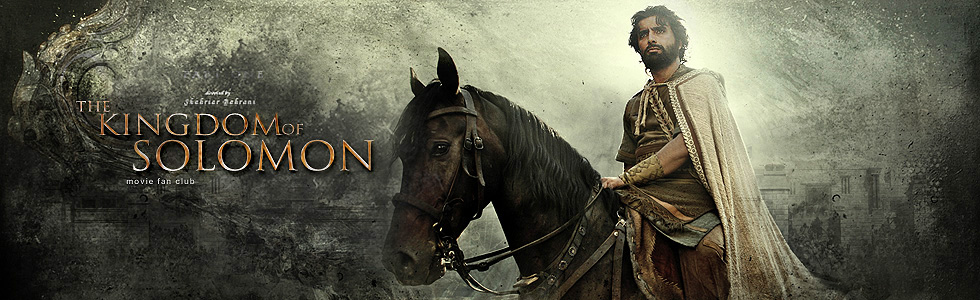
The Quranic account of the story of Soleiman and the Queen of Sheba ends here. There are several stories (from the Old and New Testaments, among others) about Soleiman and the Queen that do not appear in Islamic traditions. The Islamic position on all such stories neither confirms nor denies them. But in the film you will see a better ending
According to the Quran, the death of Soleiman was a lesson to be learned,
Then, when We decreed (Solomon's) death, nothing showed them his death except a little worm of the earth, which kept (slowly) gnawing away at his staff: so when he fell down, the Jinns saw plainly that if they had known the unseen, they would not have tarried in the humiliating Penalty (of their Task). [Quran S34:A14]
When Soleiman was to die, he stood up in prayer holding his cane. There he silently died, but, by Allah's will, did not fall. He remained in this position, and everyone including the Jinns thought that he was still alive. Finally Allah took back the jinns into their own worlds and then ordered a termite to weaken the cane so that the body of Soleiman fell. It was thereafter believed that the Jinn (along with all humans) did not know everything and only Allah had knowledge of all.
Quranic References about Prophet Solomon (PBUH)
- Appraisals for Sulayman: [Qur'an 6:84], [Qur'an 27:15], [Qur'an 27:16], [Qur'an 21:81], [Qur'an 21:82], [Qur'an 27:18], [Qur'an 27:19], [Qur'an 27:21], [Qur'an 27:20], [Qur'an 27:22], [Qur'an 27:23], [Qur'an 27:36], [Qur'an 27:37], [Qur'an 27:38], [Qur'an 27:39], [Qur'an 27:44], [Qur'an 34:12], [Qur'an 34:13], [Qur'an 38:30], [Qur'an 38:31], [Qur'an 38:35], [Qur'an 38:36], [Qur'an 38:37], [Qur'an 38:38], [Qur'an 38:39], [Qur'an 38:40]
- Sulayman's preaching: [Qur'an 4:163], [Qur'an 27:25], [Qur'an 27:31], [Qur'an 27:44]
- Sulayman judged: [Qur'an 21:78] [Qur'an 21:79]
- Fitnah to Sulayman: [Qur'an 38:32], [Qur'an 38:33], [Qur'an 38:34]
- Sulayman and Queen Balqis: [Qur'an 27:28], [Qur'an 27:29], [Qur'an 27:30], [Qur'an 27:31], [Qur'an 27:34], [Qur'an 27:35], [Qur'an 27:36], [Qur'an 27:37], [Qur'an 27:38], [Qur'an 27:39], [Qur'an 27:40], [Qur'an 27:41], [Qur'an 27:42], [Qur'an 27:43], [Qur'an 27:44]
- The kingdom of Sheba: [Qur'an 27:23], [Qur'an 34:15], [Qur'an 34:18]
- Sulayman's death: [Qur'an 34:14]